

Yiddish History Course Overview
-
What was Jewish life like in Eastern Europe?
-
How did the political and economic upheavals of the 19th and 20th centuries change Jewish Eastern European culture, and how do these changes still inform historical and cultural memory today?
-
How did the changes in traditional Jewish life relate to gender and the place of women in society (and importantly, how do we queer these historical narratives)?
-
Who were the Bund, and what was their relation to socialist movements of the time?
-
What is a Shtetl, and how was it distinct from other types of communal settlement in Europe?
In this course we explore these (and other) questions, focusing on the social, cultural and political changes that shaped the lives and cultures of Jews in Eastern Europe. Drawing on a wealth of literary, musical, and visual materials, as well as archival and historical documents, we will encounter poets, radicals, artists, musicians, and revolutionaries who lived, created and dreamed in Yiddish, and learn how they thought about their world and sought to change it for the better!
Our course takes place on the traditional, ancestral, and unceded territories of the xʷməθkʷəy̓əm (Musqueam), Sḵwx̱wú7mesh (Squamish), and Səlilwətaɬ (Tsleil-Waututh) Nations. In our collective study and inquiry, we are indebted to the Nations who have been caretakers, custodians, and protectors of this land since time immemorial. This course aims to critically reflect on our narratives, historical memory, and practices within a commitment to the process of reconciliation and decolonization.
The Zhargon program was relaunched in 2025 as part of the Peretz Centre's Discovering Doikayt initiative. We acknowledge the support of the Canadian Race Relations Foundation with funding provided by the Government of Canada.
The most enduring maskilic term of opprobrium for Yiddish was zhargon ("jargon"). Derived from an Old French word for the jabbering of birds, the term has come to mean either the inscrutable language of a closed group or a debased, uncivilized form of speech — in either case, something less than a full, proper language. [...] By the turn of the twentieth century, the use of zhargon ranged considerably in connotation, having become for some Jews, in effect, the name of the Ashkenazic vernacular.
-- Jeffrey Shandler, Yiddish: Biography of a Language
Tseydo-ladeyrekh / צדה-לדרך
(Food/Preparation for the Journey)
Khavershaft
Exploring Jewish history is exciting and fascinating (and fun!), but can also confront us with difficult histories, trauma, and deep questions about personal and collective identity. Before gaining knowledge, our commitment is to each other and to our learning. Let us commit to creating a space of inquiry, critical questioning, respect for each other, and mutual support.
Identity
Our goal in this course is to approach the histories of the Yiddish-speaking world with curiosity, respect, and a critical mind, as well as make space for personal exploration and expression. We acknowledge that everyone is coming to this class from a different place, and we want to make space for individual learning within the space of our collective process.
Knowledge
We all bring different forms of knowledge, experiences, and perspectives to the table, and all of these are part of our learning together.
We will meet some real experts along the way, but ultimately, the processing, questioning, and knowledge creation will be up to us as a group.
Topics & Themes in Yiddish History
The Origins of Yiddish
Where did Ashkenazi Jews come from? What did Jewish life look like in Eastern Europe? How did the different upheavals, changes, and crises shape Eastern European Jewish communities? Where was Yiddish born?
We will look at the movement of Jewish communities from Central to Eastern Europe, from medieval times to the eve of WWII.


The Shtetl
What do we really know about the Shtetl, a unique type of Jewish settlement, exclusive to Eastern Europe? How did literary, artistic and cinematic images influence our perception of shtetl life, and how do these representations differ from the daily realities?
Drawing from diverse sources, we will get to know a bit about life in the shtetl across different historical periods.
Jewish Life in Transition
The life, traditions and culture of the Jewish shtetl exhibit profound richness, beauty and significance. At the same time, they were deeply embedded within broader social and political structures, both within and outside the Jewish community.
We will explore stories of tradition and change, and study the radical changes faced by Jewish communities with the advent of modernity.


Jewish Political Movements
Autonomism vs. Territorialism, Bundism vs. Zionism, Communism, Diaspora Nationalism… These are some of the political movements and ideologies that swept across Eastern Europe in the early 20th century.
We will work to understand what some of these movements stood for, the complex relationships and rivalries between them, and their influence on broader social and political changes in 20th century Europe (and beyond).
Pictured (edited): Election poster of the General Jewish Labour Bund in Kyiv (artist unknown) , 1917 (via Wikimedia Commons)
Guest Lectures from Yiddish Scholars & Artists
.png)
Since 2021 (when the first Zhargon course was offered), each Zhargon cohort extends and opens our classroom learning with a series of public, online lectures that broaden our perspectives of Yiddish history and culture.
The Zhargon Speaker Series brings leading figures in Yiddish Studies and contemporary Yiddish arts and culture to share their work and engage in a live discussion with participants. A selection of recorded lectures are available on our YouTube channel.


Zhargon Resources at the Kirman Library
A selection of course texts and books for further reading will be available at the Peretz Centre's Kirman Library, which is open to the public by appointment. (Peretz members have borrowing privileges.)
 Language in Time of Revolutionby Benjamin Harshav (University of California Press, 1993) |  The Meaning of Yiddishby Benjamin Harshav (University of California Press, 1990) |  History of the Yiddish Languageby Max Weinreich (University of Chicago Press, 1980) |  Modern Yiddish Culture: The Story of the Yiddish Language Movementby Emanuel Goldsmith (Fordham University Press, 1987) |
|---|---|---|---|
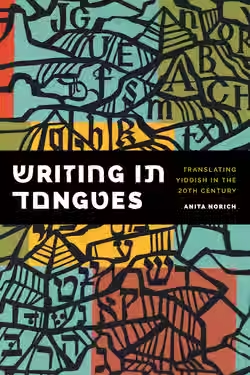 Writing in Tongues: Translating Yiddish in the Twentieth Centuryby Anita Norich (University of Washington Press, 2014) |  Architects of Yiddishism at the Beginning of the Twentieth Century: A Study in Jewish Cultural Histoby Emanuel S. Goldsmith (Fairleigh Dickinson University Press, 1976) |  Found Treasures: Stories by Yiddish Women WritersEdited by Frieda Forman , Ethel Raicus , Sarah Silberstein Swartz (Second Story Press, 1994) |  Shtetl: A Vernacular Intellectual Historyby Jeffrey Shandler (Rutgers University Press, 2014) |
 Born to Kvetch: Yiddish Language and Culture in All of Its Moodsby Michael Wex (Harper Perennial, 2006) |  Polish Jewish Culture Beyond the Capital: Centering the PeripheryEdited by Halina Goldberg and Nancy Sinkoff, with Natalia Aleksiun (Rutgers University Press, 2023) |  Radical Jewish Politics: A Global PerspectiveEdited by Nathaniel Deutsch, Alma Rachel Heckman, and Tony Michels (Rutgers University Press, 2025) |  Jewish Radicals: A Documentary HistoryEdited by Tony Michels (NYU Press, 2012) |
 The First Modern Jew: Spinoza and the History of an Imageby Daniel B. Schwartz (Princeton University Press, 2012) |  The Enemy at His Pleasure: A Journey through the Jewish Pale of Settlement during World War Iby S. Ansky, edited and translated by Joachim Neugroschel (Metropolitan Books, 2002) |  Old Jewish Folk Music: The Collections and Writings of Moshe BeregovskiTranslated and edited by Mark Slobin |  Voices of a People: The Story of Yiddish Folk Songby Ruth Rubin (T. Yoseloff, 1963) |
 Bad Rabbi: And Other Strange but True Stories from the Yiddish Pressby Eddy Portnoy (Stanford University Press, 2017) |  Yiddish Lives On: Yiddish Lives On Strategies of Language Transmissionby Rebecca Margolis (McGill-Queen's University Press, 2023) |  A Birdge of Longing: The Lost Art of Yiddish Storytellingby David Roskies (Harvard University Press, 1996) |  Yiddish: A Nation of Wordsby Miriam Weinstein (Steerforth Press, 2001) |
 I. L. Peretz and the Making of Modern Jewish Cultureby Ruth R. Wisse (University of Washington Press, 2015) |  The Dybbuk: Between Two Worldsby Sh. An-Sky, translated S. Morris Engel (Regnery/Gateway, 1974) |  Sing, Stranger: A Century of American Yiddish Poetry—A Historical AnthologyEdited by Benjamin Harshav, translated by Barbara Harshav & Benjamin Harshav (University of Stanford Press, 2006) |  Fear and Other Storiesby Chana Blankshteyn, translated by Anita Norich (Wayne State University Press, 2022) |
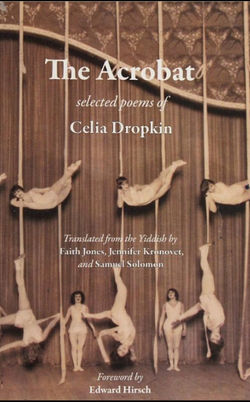 The Acrobat: Selected Poems of Celia Dropkinby Celia Dropkin, translated by Faith Jones, Jennifer Kronovet, & Samuel Solomon |  Proletpen: America's Rebel Yiddish PoetsEdited by Amelia Glaser, & David Weintraub, translated by Amelia Glaser (University of Wisconsin Press, 2005) |  American Yiddish Poetry: A Bilingual Anthologyby Benjamin Harshav and Barbara Harshav (Stanford University Press, 2006) |  Reading Women: Marginality and Modernization in Nineteenth-Century Eastern European Jewish Societyby Iris Parush, translated by Saadya Sternberg (Brandeis University Press, 2004) |
 Jewish Life in Renaissance Italyby Robert Bonfil, translated by Anthony Oldcorn (Unviersity of Californiai Press, 1994) |  Jewish Musical Traditionsby Amnon Shiloah (Wayne State University Press, 1995) | 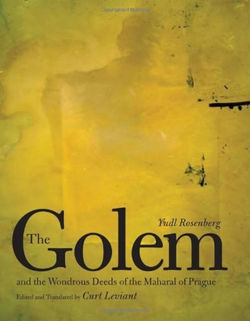 The Golem and the Wondrous Deeds of the Maharal of Pragueby Yudl Rosenberg, edited and translated by Curt Leviant (Yale University Press, 1997) |  Moscow Yiddish Theater: Art on Stage in the Time of Revolutionby Benjamin Harshav (Yale University Press, 2007) |
 The Shtetl: A Creative Anthology of Jewish Life in Eastern Europeby Joachim Neugroschel (Richard Marek Publishers, 1979) |  The Marxists and the Jewish Question The History of a Debate (1843-1943)by Enzo Traverso, translated by Bernard Gibbons (Humanities Press, 1994) |
Upcoming Yiddish History Courses

Zhargon Curriculum Creators

Itamar Manoff is co-executive director of the Peretz Centre. A PhD in Educational Studies, Itamar is a community educator, language teacher and learner, and Jewish history enthusiast.
He is a graduate of the Wallis Annenberg Helix-Yiddishkayt Fellowship (2018–2019), and the Yiddish Book Center's Yiddish Pedagogy Fellowship (2025–2026). Itamar is also the co-founder of This is Not an Ulpan, a grassroots, cooperative language school dedicated to the principles of critical pedagogy and emancipatory education in Palestine and Israel.

Jess Goldman is a writer, comics artist, and amateur puppeteer based on the traditional, unceded lands of the Squamish, Tsleil-Waututh, and Musqueam peoples.
Their writing has been published in Maisonneuve, the CBC, and Room Magazine. Their story “Tombstone of a Tsaddik” won the 2025 Bronwen Wallace Award for Short Fiction. A graduate of University of British Columbia’s MFA in Creative Writing Program, their writing explores that sweet spot where Yiddishkayt and queer culture joyfully collide.